
Six months of voice complaints. Resolved in four days.


Author: Jamie Litherland,
VP Business Development,
VOSS Solutions
Tuesday August 18, 2026
I’ve been sharing a series of real-world use cases recently – situations where the right visibility tooling made the difference between months of frustration and a clean, fast resolution. This one is a good example of both. Intermittent problems are the hardest kind to solve. They don’t reproduce on demand. They don’t show up cleanly in dashboards. And when they cross team boundaries – as they almost always do – they tend to generate a lot of activity without producing much resolution.
A managed services firm operating across twelve regions had been living with exactly this kind of problem for the better part of six months. Users in certain locations were reporting intermittent voice quality issues on Microsoft Teams calls – breakup, latency, occasional drops. The pattern was inconsistent enough to resist diagnosis and dispersed enough across the estate that no single team owned the investigation in any meaningful way.
The network team reviewed QoS policies. The UC team checked Teams call quality dashboards. Support tickets were raised, investigated, and closed. The complaints kept coming.
When VOSS was brought in, the first thing we deployed was VOSS NetFlow across the affected sites. Within 48 hours, a pattern had emerged that hadn’t been visible through any of the existing tooling. At three of the worst-affected locations, Teams media traffic was being routed through VPN concentrators that were hitting capacity thresholds during peak usage windows – roughly 10–11am and 2–3pm daily. The issue wasn’t with Teams. It wasn’t with the local network. It was a bandwidth contention problem at a specific point in the path, and it was only visible when you could see the full traffic flow end to end.
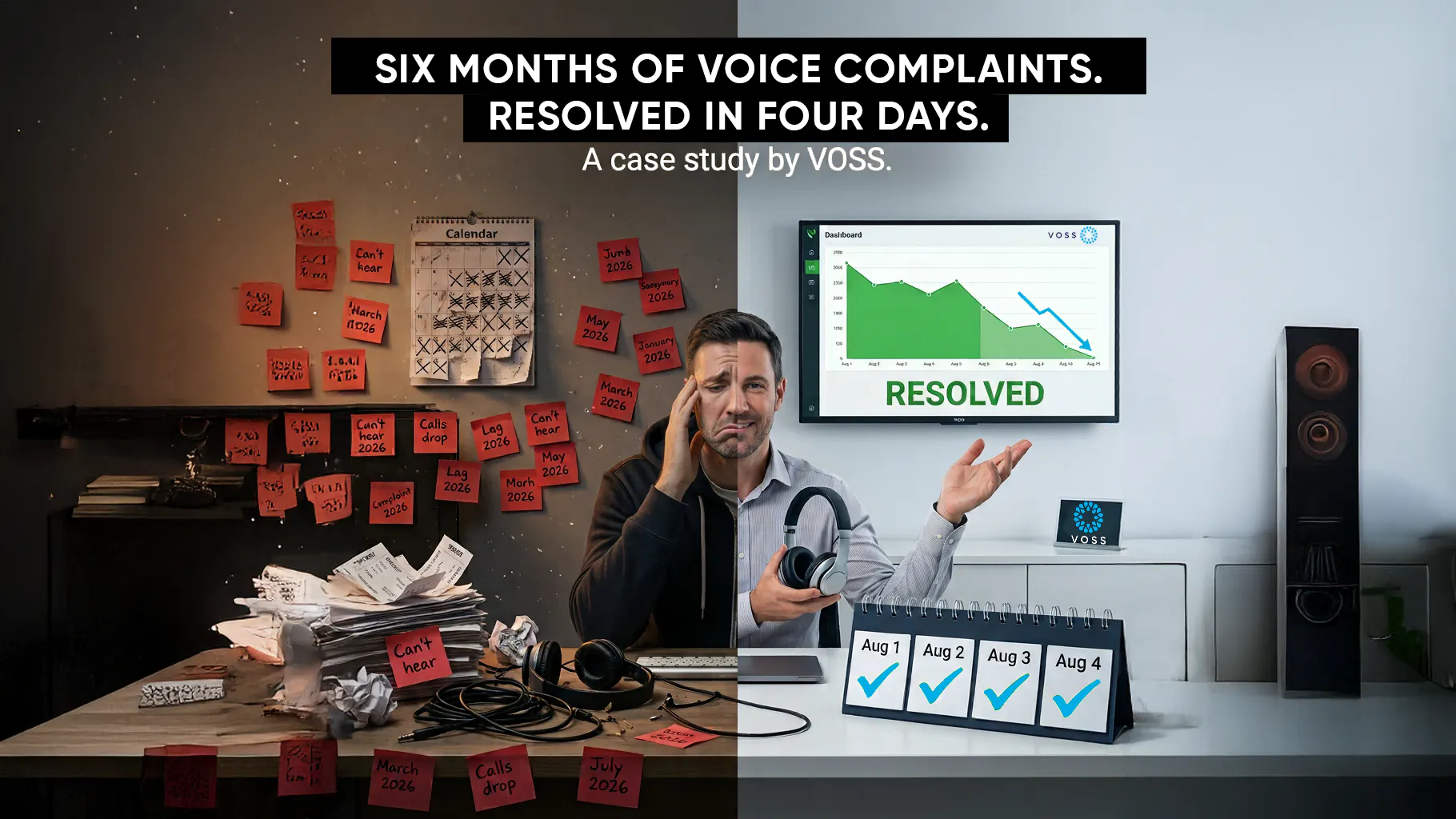
Armed with that data, the network team made targeted capacity adjustments and implemented media bypass for Teams traffic at those locations. The voice quality complaints stopped within days.
What stayed with the IT director wasn’t the speed of the fix – it was the question it raised. The same traffic data that solved this problem in four days had theoretically been available for six months. What was missing wasn’t information; it was the ability to see across the entire path, rather than just the slice each team was responsible for.
This is the structural challenge that VOSS NetFlow addresses. In a modern digital workplace environment, a voice call doesn’t live in one team’s domain. It traverses network infrastructure, VPN concentrators, cloud gateways, and platform-level services – each owned and monitored by different teams with different tooling and different frames of reference. When something goes wrong, every team can check their slice and find it clean. The problem lives in the gaps.
NetFlow doesn’t replace UC or network tooling. It connects them. By capturing traffic flow data across the full path – not just individual segments – it provides the cross-domain visibility that transforms an unsolvable intermittent problem into a straightforward root cause analysis. You can see what’s actually moving, where it’s going, what it’s competing with, and when.
For organizations managing complex estates where voice quality problems resist diagnosis, that visibility isn’t a nice-to-have. It’s the difference between six months of open tickets and four days to resolution. If you’ve got voice quality issues that no single team can crack, the answer is probably sitting in the traffic data. We can help you find it, please get in touch.
Keep up to date with our latest blogs and subscribe today