
Why APAC organizations are rethinking digital workplace control



Author: Brett Johnson,
General manager APAC,
VOSS Solutions
Tuesday May 26, 2026
Since joining VOSS in January this year, one thing has become increasingly clear to me as I talk to enterprises, universities, and service providers across APAC: digital workplace complexity is no longer the biggest challenge facing IT teams.
The real challenge is maintaining operational consistency and control as environments evolve.
Across the region, organizations are managing increasingly distributed workforces, expanding collaboration platforms, growing security requirements, and constant pressure to do more with leaner IT teams. At the same time, many are navigating a mix of internal operations, outsourced services, and multiple technology providers – all while trying to deliver a seamless user experience. In many cases, the result is operational fragmentation.
Different providers manage different parts of the environment. Administrative processes become inconsistent. Governance varies between teams. Costs increase through ongoing change requests and manual administration. Over time, organizations lose visibility and control over the very systems designed to improve productivity.
The challenge of consistency through change
This is particularly visible in large, complex institutions across APAC, where scale and decentralization create additional operational pressure.
One recent customer example highlights this challenge perfectly.
A major university in Asia Pacific, supporting more than 53,000 students and over 13,000 staff across multiple campuses and departments, has spent more than a decade evolving its digital workplace strategy. Over that time, the institution transitioned between in-house operations and multiple managed service providers (MSPs) responsible for its telephony and collaboration environment.
But despite those changes, one thing remained consistent: VOSS UC Automation.
For me, this is the most important takeaway from the story. The real value wasn’t simply automation. It was consistency through change.
While service providers evolved and operational models shifted, the university maintained a centralized management and automation layer that continued to deliver governance, visibility, and operational continuity. That meant the organization could modernize its environment without constantly redesigning workflows, retraining administrators, or rebuilding operational standards.
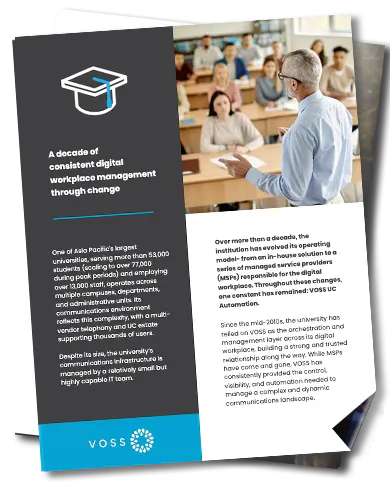
Read this case study, or download the PDF
Lean IT teams managing growing complexity
Today, the university uses VOSS to manage approximately 8,000 knowledge workers through automated provisioning, role-based access control, onboarding and offboarding workflows, and centralized administration.
What stands out is how a relatively small IT team has been able to maintain control across such a large and distributed environment. That’s increasingly becoming the defining challenge for organizations across APAC.
Hybrid work has accelerated the need for secure remote administration and granular role-based access. Multi-vendor environments are now the norm rather than the exception. Data sovereignty requirements continue to shape operational decisions. And many organizations are reassessing how they optimize day-to-day operational engagements with MSPs, balancing external expertise with greater internal visibility and control.
Importantly, this does not mean MSPs are disappearing. Far from it. MSPs continue to play a critical role in delivering strategic expertise, operational scale, and service innovation. But organizations are becoming more selective about where they want external support and where they want direct operational ownership. Increasingly, they want a consistent automation and governance layer that sits above provider transitions, platform changes, and evolving workplace strategies.
Digital workplace management becomes strategic
That shift is why digital workplace management is becoming a much more strategic conversation across APAC. It is no longer just about provisioning users or managing collaboration tools. It is about creating operational resilience as environments become more dynamic.
Looking ahead, this university is now exploring a transition toward a cloud-based operating model to further improve scalability, cost management, and operational agility. Because VOSS already acts as the management and automation layer, the institution is well positioned to adopt additional technologies and services without adding unnecessary operational complexity.
That flexibility will become increasingly important as organizations expand into adjacent areas such as security, compliance, AI-driven operations, and broader digital workplace management.
Building operational resilience for the future
In APAC, the organizations succeeding in digital workplace transformation are not necessarily the ones adopting the most technology. They are the ones building operational consistency across change. If your organization is based in APAC and you would like to discuss your digital workplace objectives, please get in touch.
Keep up to date with our latest blogs and subscribe today