Looking to accelerate contact center migration? Read on!


Author: Jamie Litherland,
Solutions Owner,
VOSS Solutions
Tuesday May 05, 2026
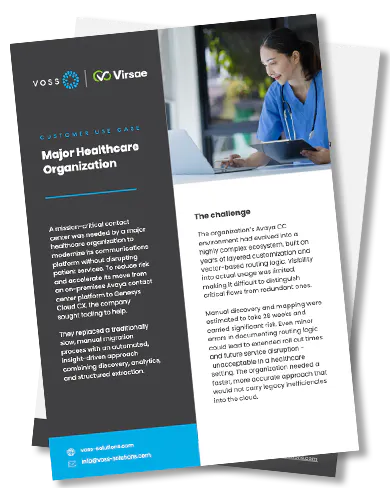
Modernizing a contact center is never simple. In healthcare, it’s even harder. When patient services depend on every call being routed correctly, any delay matters and each misstep carries risk. This makes large-scale platform migrations particularly challenging, and was exactly the situation facing one major healthcare organization as it prepared to move away from its legacy Avaya Contact Center environment and transition to Genesys Cloud CX.
The goal was clear: modernize the platform, reduce complexity, and take advantage of cloud flexibility. The problem? Getting there without disruption.
When complexity becomes the real risk
Like many long-standing contact center environments, the organization’s Avaya platform had evolved over time. Layers of customization had been added over the years, with complex vector-based routing logic sitting at the heart of operations. It wasn’t always clear which routing flows were critical, which were rarely used, and which were simply legacy artifacts that no longer served a purpose.
The lack of clarity created a serious challenge for migration planning. Initial estimates suggested it would take around 28 weeks to fully document, map, and validate the existing environment. Even then, there was a high risk of error. Misinterpreting routing logic or missing dependencies could lead to delays, rework, or worse – service disruption.
Rethinking the migration approach
Rather than following the traditional path of manual discovery and documentation, the organization took a different approach. Working with VOSS and our partner Virsae, they shifted to a model built on automation and data.
Instead of trying to interpret the environment manually, they used automated discovery to extract the full configuration directly from the platform. This included everything from call flows and vectors to the underlying routing logic that determined how patient interactions were handled.
Complex configurations were translated into clear, visual call flows. Relationships between systems and services became easier to understand. And perhaps most importantly, the organization could finally see how its contact center actually operated.
From visibility to better decisions
With that clarity came a second layer of insight: real usage data. Analytics revealed how the contact center behaved in practice – call volumes, concurrency levels, agent utilization, and traffic patterns. This allowed the team to move beyond assumptions and design based on reality.
Instead of lifting and shifting the existing environment, they were able to simplify it. Redundant logic was removed. Inefficient routing paths were eliminated. The target architecture was redesigned to reflect actual demand, not historical complexity.
Building for the cloud
Once the environment was understood and streamlined, the next step was rebuilding it in Genesys Cloud CX. Here again, automation played a critical role. The solution generated structured outputs, including Excel datasets, Visio diagrams, and detailed blueprint documentation. These were practical tools that supported direct configuration in the new platform. As a result, the rebuild process was faster, more consistent, and far less prone to error. Instead of manually recreating complex routing logic, teams worked from validated, clearly defined models. That significantly reduced deployment risk and accelerated the overall timeline.
The outcome: faster, safer, and more efficient
What had originally been estimated as a 28-week migration was completed in just 8 weeks. Automated discovery took around four weeks of that time, and the platform deployment took less than one.
By removing unnecessary complexity and aligning the new environment with real usage patterns, the organization also improved operational efficiency. Licensing was optimized, routing was simplified, and the overall platform became easier to manage and scale. Most importantly, this was achieved without disrupting patient services.
This use case highlights a broader shift in how organizations are approaching UC and contact center transformation. Migration is no longer just about moving from one platform to another. It’s about understanding what you have, deciding what you actually need, and using data to guide that journey. When discovery, analytics, and automation come together, the process becomes faster, more accurate, and significantly lower risk.
To find out more about this migration project, please contact us.
Keep up to date with our latest blogs and subscribe today