Rethinking Microsoft license management


Author: Tim Jalland,
Program Director,
VOSS Solutions
Wednesday June 10, 2026
Microsoft licensing is becoming one of the most strategically important operational considerations for an enterprise. As organizations expand their use of Microsoft 365, Teams and Phone, Copilot, advanced security, compliance services, and premium bundles like E5 – with E7 now entering the conversation at a reported $99 per user per month – enterprise licensing environments are becoming significantly more sophisticated. At the same time, organizations are under increasing pressure to ensure users have access to the right tools, services, and experiences to remain productive, secure, and collaborative.
This evolution is creating a new operational challenge for enterprise IT leaders: how do you maintain visibility, governance, and alignment across a rapidly expanding Microsoft ecosystem?
A recent article from Directions on Microsoft explored Microsoft’s “Multiple Equivalent Offer” (MEO) strategy and the increasing sophistication behind enterprise licensing discussions. The analysis highlighted how Microsoft is continuing to evolve its commercial models to encourage broader platform adoption and deeper integration across productivity, security, compliance, collaboration, and AI services. For enterprises, this reflects a broader reality: Microsoft environments are no longer static. They are dynamic, fast-moving operational platforms that require continuous visibility and management.
The growing complexity of enterprise licensing
In my experience, one of the most overlooked costs is manual administration. Even basic UC and collaboration systems require ongoing provisioning, configuration, and troubleshooting. And the larger your digital workplace, the bigger the problem is. IT teams spend countless hours handling routine requests, updating settings, and resolving issues that could easily be automated. These repetitive tasks don’t just consume time – they carry a measurable financial burden. By automating these processes, our customers free their IT staff to focus on strategic initiatives, rather than firefighting day-to-day problems.
Fragmented communication environments introduce another hidden expense. Many businesses rely on a mix of Teams, Webex, and SIP-based solutions. Individually, these platforms may function adequately, but together they create inconsistencies in user experience, policy enforcement, and system maintenance. Employees lose time switching between tools, resetting passwords, or submitting support tickets, while IT struggles to maintain oversight. A unified management layer ensures consistent experience across all systems and reduces the operational overhead of managing disparate platforms.
Shadow IT adds yet another layer of hidden cost. When standard digital workplace tools fail to meet user expectations, employees often adopt unauthorized apps or external services. These workarounds may temporarily solve the problem, but they introduce security risks, compliance gaps, and unexpected expenses. Without visibility into these systems, organizations cannot fully grasp the total cost of their communications environment. Tools that actively discover and manage all UC, collaboration, and productivity assets – including those outside formal oversight – turn invisible risks into measurable, manageable data points.
Beyond costs and inefficiencies, a sub-par digital workplace platform will quietly erode productivity. Manual processes, delayed onboarding, and slow adoption will impact decision-making and reduce employee efficiency. A poorly managed digital workplace can also impact customer interactions; creating frustration and weakening confidence. When communication tools fail to facilitate seamless collaboration, opportunities are missed, deals are delayed, and teams spend more time solving problems than innovating.
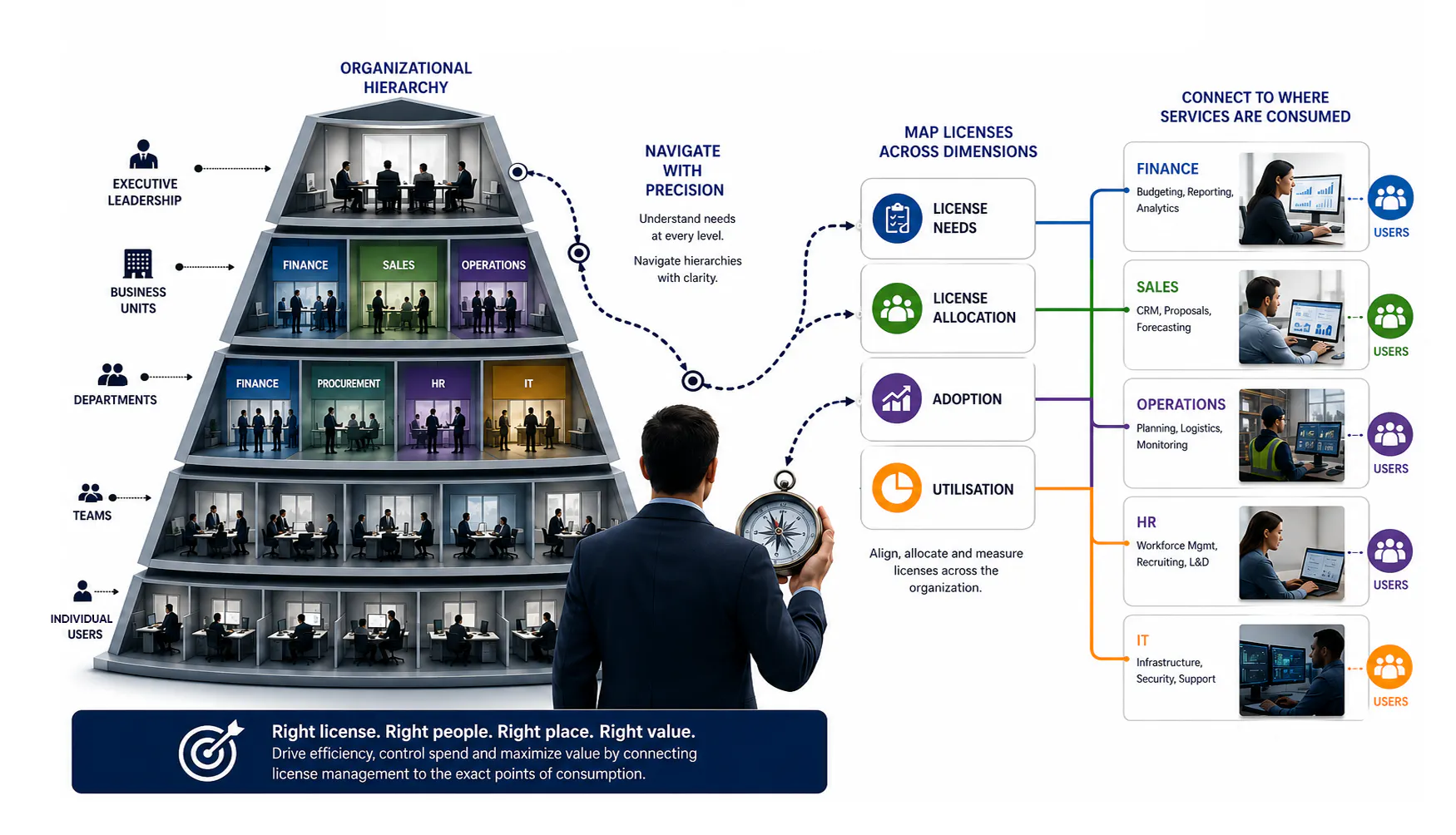
Navigate hierarchies. Map license needs. Connect to where services are consumed.
You won’t solve the problems outlined above, simply by replacing one platform with another. And, if the status quo is no longer acceptable, what is? VOSS offers intelligent automation management and analytics which empower our customers to treat their digital workplace platform as a strategic asset rather than a utility. We give real-time insight into system usage, user experience, and operational efficiency, allowing predictive monitoring, automated processes, and consistent governance across your platform. With VOSS, your digital workplace becomes measurable, manageable, and aligned with your business outcomes.
Why workforce personas matter
Modern enterprises are made up of highly diverse user groups. Developers, frontline workers, hybrid employees, executives, contractors, contact center agents, and knowledge workers all require different combinations of productivity, communication, security, and compliance capabilities. However, many organizations continue to deploy standardized licensing models because they lack the operational visibility needed to confidently align services with business roles.
Persona-based license management changes this approach. Instead of applying broad licensing policies uniformly, organizations can align Microsoft capabilities more closely to how users actually work, ensuring employees receive the services most relevant to their role while improving operational consistency. Crucially, this persona visibility must extend across the organizational hierarchy: from enterprise-wide policy down to individual business units, regional teams, and specialist user groups. That granularity is what makes it possible to monitor consumption accurately, enforce governance at the right level, and attribute costs fairly across the business.
The importance of visibility before renewal
Many organizations only begin reviewing their licensing environment shortly before an enterprise agreement renewal or true-up cycle. By then, opportunities to fully assess usage trends, workforce requirements, and adoption patterns may already be limited. Effective planning requires continuous visibility – access to historical usage trends, regional adoption data, inactive accounts, and how Microsoft services are supporting business productivity over time. Without that intelligence, it becomes difficult to confidently align licensing strategy with organizational goals.
From license administration to operational intelligence
Third-party license management platforms provide the visibility enterprises need to manage Microsoft environments more effectively at scale. Organizations need centralized insight into license allocation, user activity, adoption, and service utilization across regions, departments, and business units – and critically, the ability to monitor and report at each level of the organizational hierarchy, supporting both governance and accurate internal chargeback.
Automation also plays a critical role. Manual license administration is increasingly difficult to sustain in large enterprise environments. Automated persona-based provisioning helps standardize license assignment according to agreed business roles and governance policies, while automated workflows can quickly surface inactive accounts, outdated entitlements, or inconsistent assignments. As Microsoft’s consumption-based model continues to develop, this kind of continuous, automated oversight will become essential to avoiding unexpected cost exposure.
Visibility is becoming essential
Microsoft licensing is no longer just a procurement exercise. It has become a critical part of broader digital workplace strategy, operational governance, and workforce enablement. The organizations that manage this transition most effectively will be the ones with the clearest understanding of their workforce personas, adoption patterns, organizational structure, and real-time service consumption – and that level of visibility requires continuous insight, intelligent automation, and independent license management designed for the realities of modern enterprise collaboration.
Keep up to date with our latest blogs and subscribe today