
The visibility gap in Webex Calling deployments



Author: Keith Bareham
Director of Solution Engineering,
VOSS Solutions
Wednesday May 13, 2026
Cloud calling promises simplicity. With platforms like Cisco Webex Calling gaining momentum, many organizations expect that moving away from on-prem infrastructure will reduce operational burden and streamline management. In some ways, it does. The infrastructure becomes someone else’s responsibility; updates happen automatically and organizations no longer need to spend time maintaining the core application stack.
But cloud communication also changes the operational landscape. The challenge is no longer managing the platform itself. Instead, the focus shifts toward managing and understanding the end-to-end user experience across networks, devices, integrations, and distributed workforces.
That shift is creating a visibility gap for many organizations. Native vendor tools are effective at managing the service itself, but they often struggle to provide a broader operational view across enterprise workflows, hybrid environments, and the wider factors that influence user experience.
A service can appear technically healthy while users experience poor call quality, inconsistent device behavior, provisioning delays, or intermittent connectivity issues. In cloud environments, performance is no longer isolated to infrastructure inside the corporate data center. Internet connectivity, remote worker environments, ISP performance, endpoint quality, and third-party integrations all become part of the communications experience.
As a result, IT teams often find themselves stuck in reactive operations. Tickets arrive before issues are identified. Troubleshooting becomes fragmented across multiple tools. And despite significant investment in cloud modernization, many organizations still lack a clear understanding of how services are performing from the user’s perspective.
The reality of modern UC environments
While cloud-first strategies are common, very few enterprises operate within a single-vendor communications environment. Most organizations are managing a combination of platforms as part of broader transformation initiatives, mergers, regional requirements, or phased migration strategies.
It is increasingly common to see Webex Calling operating alongside Cisco UCM, Microsoft Teams, legacy telephony platforms, contact center technologies, and other collaboration services. In many cases, this coexistence is entirely intentional. Different platforms may serve different business units, geographic regions, or operational requirements. The challenge is not simply the presence of multiple vendors. It is the operational fragmentation that often follows.
Each platform introduces its own administration portals, analytics tools, APIs, workflows, and reporting structures. IT teams are forced to move between disconnected systems to complete routine operational tasks, investigate issues, or extract service insights. Over time, this creates inefficiencies, inconsistent processes, and gaps in visibility.
Even organizations operating predominantly within a single ecosystem can encounter these challenges. As cloud services evolve, enterprises increasingly need deeper operational intelligence, greater workflow flexibility, and more integration into broader IT and business processes than native tooling alone typically provides.
The operational shift in cloud communications
The move to cloud changes what organizations need to monitor and manage.
Historically, communications teams focused heavily on infrastructure availability. If the servers, gateways, and networks inside the organization were operational, the environment would be considered healthy. In cloud environments, that model no longer applies.
The underlying platform becomes more of a managed service – effectively a black box – and that is not necessarily a bad thing. Organizations benefit from reduced infrastructure management, faster innovation cycles, and simplified service delivery.
However, operational priorities shift upward.
The focus becomes understanding user experience across the entire service chain:
This requires a broader operational approach that combines monitoring, analytics, and automation into a unified operational layer.
Beyond monitoring alone
This is where organizations increasingly look beyond traditional vendor-native management tools.
Modern UC operations require more than basic service monitoring. They require the ability to consolidate operational data, automate processes, surface meaningful analytics, and integrate communications management into wider enterprise operations.
VOSS provides value across both single-vendor and multi-vendor environments. Rather than focusing purely on monitoring infrastructure, we deliver a broader operational framework across cloud and hybrid UC environments:
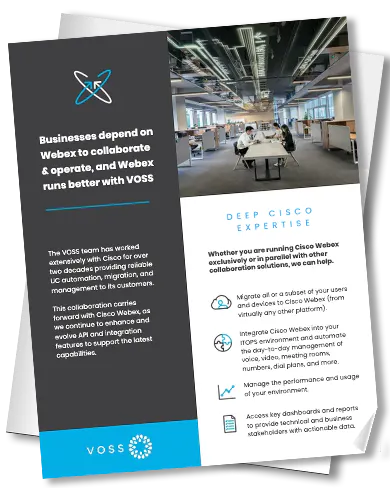
Whether using Webex alone or with other solutions, we can help. Read on
This operational flexibility becomes increasingly important as organizations modernize IT operations and introduce AI-driven workflows. Communications platforms can no longer operate as isolated silos. They need to integrate cleanly into broader enterprise automation strategies, service management processes, and analytics initiatives.
At the same time, different operational teams require different levels of visibility and control. Service desk teams, operations teams, executives, and managed service providers often need access to different analytics, workflows, and operational insights. Flexible RBAC and customizable interfaces help organizations simplify operations while ensuring teams remain focused on the metrics and tasks most relevant to them.
Supporting migration without operational disruption
These capabilities become particularly valuable during migration and transformation initiatives.
Organizations moving from legacy platforms such as Avaya or transitioning from on-prem Cisco UCM to Webex Calling are rarely able to execute large-scale “big bang” migrations. Most enterprise transitions happen gradually, with coexistence lasting months or even years.
During that time, IT teams must manage both legacy and cloud environments simultaneously while maintaining service quality and minimizing operational disruption. Without a unified operational layer, teams often fall back into disconnected management processes and reactive troubleshooting.
The challenge is not migration itself; it is maintaining operational consistency, visibility, and efficiency throughout the transition and beyond.
From platform management to service intelligence
Cloud communications are reshaping what successful UC operations look like. The goal is to understand how communications services are performing across the full enterprise experience and ensuring operations can scale efficiently as environments evolve. This requires a combination of monitoring, analytics, automation, and operational intelligence that extends beyond the native platform itself.
Webex Calling provides a powerful cloud communications foundation. But long-term success depends on the operational layer around it – the ability to gain visibility across the entire environment, automate workflows, surface meaningful analytics, and continuously optimize the user experience. That is where organizations increasingly differentiate between simply adopting cloud communications and truly operationalizing them at an enterprise scale.
To find out more about how VOSS supports Cisco UC platforms, please get in touch.
Keep up to date with our latest blogs and subscribe today