
Why AI needs an automation fabric, not another script


Author: Mike Frayne,
Chief Executive Officer,
VOSS Solutions
Tuesday August 11, 2026
Every enterprise is asking a version of the same question right now: if AI can generate code, automate workflows, and connect systems in seconds, do we still need platforms built on deep domain expertise? It is an understandable question; but is it the right one?
AI lowers the cost of code to near zero. What it does not lower is the cost of knowing what to build, how to configure it, and what good looks like. That cost is domain knowledge, paid in years of experience. AI can learn too, but only from data and feedback that already encodes that expertise. A vibe-coded solution answers the question you asked; domain knowledge tells you whether you asked the right one.
This distinction matters more than most organizations realize when they start experimenting with AI-generated scripts and low-code orchestration tools. AI accelerates execution. Without domain knowledge guiding what to build, you move faster – but in the wrong direction. There is no specification for good, baked into a language model. Knowing which metrics matter, which automations are worth building, and what outcomes to target, is a judgment problem, not a code generation problem. But there is also a data problem. If the appropriate data is not up to date, accurate and has not been collected, aggregated, collated and augmented, even great code cannot produce meaningful insights!
The hidden cost of vibe-coded automation
Many organizations are now assembling fragmented automation environments from disconnected scripts, isolated integrations, and unmanaged AI agents. Initially, this can look agile and cost-effective. And for simple, surface-level tasks, it often is. Teams move quickly, workflows appear to improve, and there is genuine excitement around what is possible.
But that ease is deceptive. It works because the easy use cases are, by definition, easy. A Slack notification, a basic ticket routing rule, a simple data sync. The moment the use case requires real domain depth – understanding how a UC platform behaves under load, how a codec path failure differs from a network-wide fault, how license entitlements cascade across a hybrid estate – vibe-coded automation has nothing to draw on. It doesn’t know what it doesn’t know. Over time, familiar problems emerge. Security gaps appear, governance becomes inconsistent, integrations turn brittle, and operational logic is duplicated across teams. Vibe-coded tools are cheap to start. Maintaining, securing, and scaling them is not. What began as accelerated innovation quietly becomes operational sprawl – and by the time that is visible, the technical debt is significant.
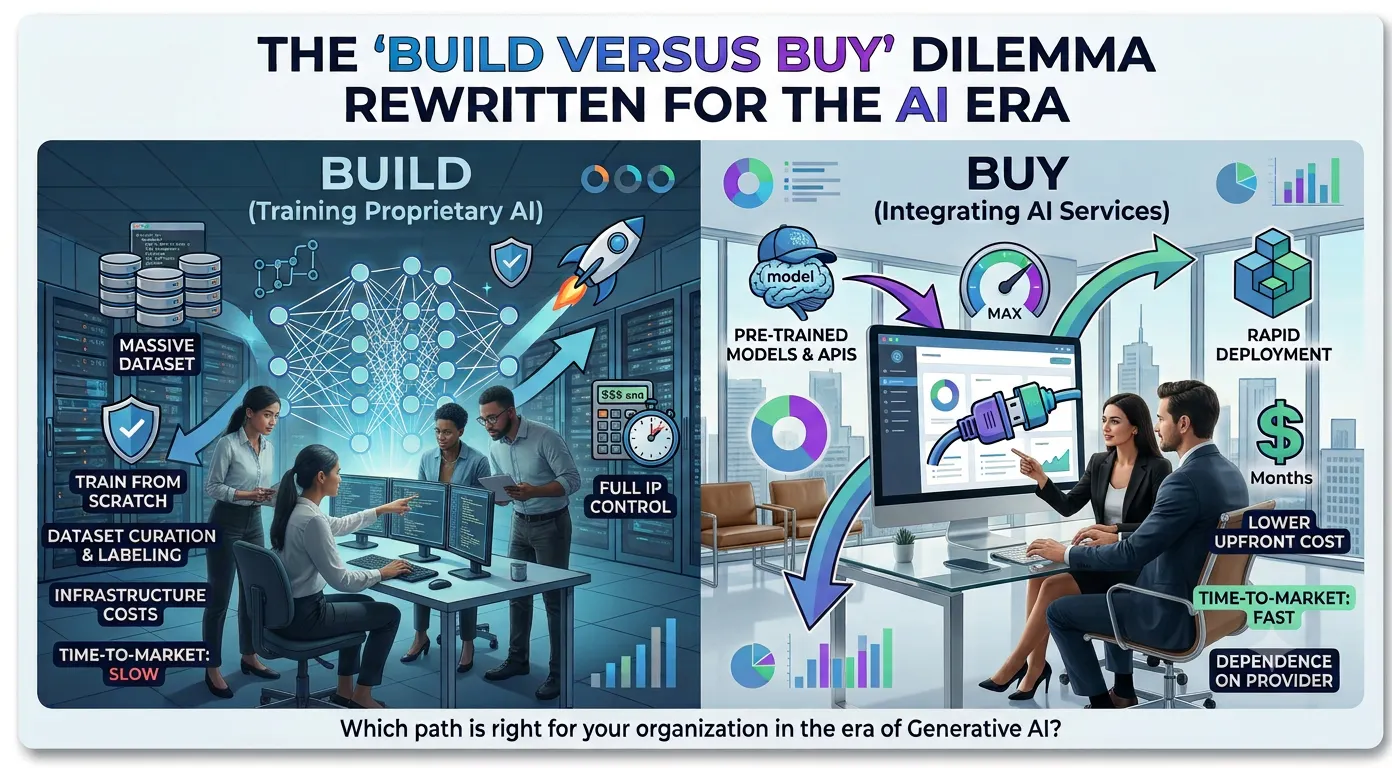
This is the “build versus buy” dilemma rewritten for the AI era. Enterprise automation requires far more than code generation. It requires knowing which automations deliver real outcomes, which edge cases will break things in production, and how platforms, workflows, policies, and user lifecycles behave at scale. AI generates code; it does not generate that judgment.
Twenty+ years of operational knowledge – and a network effect
This is where VOSS delivers something no internal AI build can replicate. For more than two decades, VOSS has invested in understanding the operational realities of enterprise communications and digital workplace management. That expertise is not trapped in documentation or consulting engagements. It is embedded directly into the platform – in the automation logic, the analytics models, the remediation workflows, and the alerting thresholds.
When customers deploy VOSS, they are not purchasing another software platform. They are gaining access to something closer to a virtual engineer – one that monitors their digital workplace platform against patterns drawn from hundreds of real deployments, spots drift and risk before symptoms appear, and distinguishes a codec path issue from a network-wide fault without a ticket being raised.
And crucially, that intelligence compounds. Every customer deployment adds to a shared knowledge layer that benefits every other customer. Cross-industry patterns from finance, healthcare, retail, and public sector deployments inform what gets built and how. Problems solved in one environment protect others before they ever encounter the same issue. The gap between VOSS and an internal build widens structurally over time – not because of feature releases, but because of accumulated operational intelligence that no single organization can replicate on its own.
Why the automation fabric becomes more critical as AI matures
As AI agents become more autonomous, enterprises will require stronger operational controls, not fewer. Agents will interact with user data, provisioning systems, communications platforms, analytics engines, and security frameworks. They will make decisions, execute actions, and trigger changes across complex environments – often without a human in the loop.
That creates governance challenges that vibe-coded tooling is entirely unequipped to handle. Organizations need to determine what an agent can access, how permissions are enforced, how actions are audited, and how AI-driven workflows align with compliance requirements and business policy. RBAC, data segmentation, compliance controls, and audit trails are not features that can be generated from a prompt. Each is a significant engineering project, in its own right.
VOSS provides the operational intelligence layer that sits between AI-driven interactions and the enterprise systems underneath them – connecting AI orchestrators, ITSM platforms, analytics tools, and business systems to domain-intelligent agents that understand the environment they are operating in. Rather than replacing that infrastructure, AI becomes genuinely powerful when it is connected to a trusted framework that already knows the context, the policies, and the operational dependencies.
The future belongs to domain-intelligent agents
The next phase of enterprise transformation will not revolve around a single AI assistant. It will revolve around ecosystems of specialized agents working together across the digital workplace – handling UC operations, license management, security monitoring, email governance, and AI agent oversight in parallel. Those agents will need to exchange information securely, execute workflows reliably, and interact with enterprise systems in ways that are auditable and compliant.
What will separate an effective deployment from a sprawling one is not the sophistication of the AI. It is the quality of the domain intelligence underneath it. VOSS domain agents are outcome-driven and continuously learning – and they supply the specialist knowledge that vibe-coded workflows and external AI agents simply lack.
Organizations that succeed in the AI era will be those that combine AI innovation with operational maturity, trusted governance, and automation foundations that get smarter with every deployment. You can vibe-code your way to a working prototype. You cannot vibe-code your way to a trusted, compliant, domain-intelligent system that gets smarter with every customer.
That is the role of the VOSS automation fabric.
If you would like to find out more about how VOSS can support your digital workplace, please get in touch.
Keep up to date with our latest blogs and subscribe today